
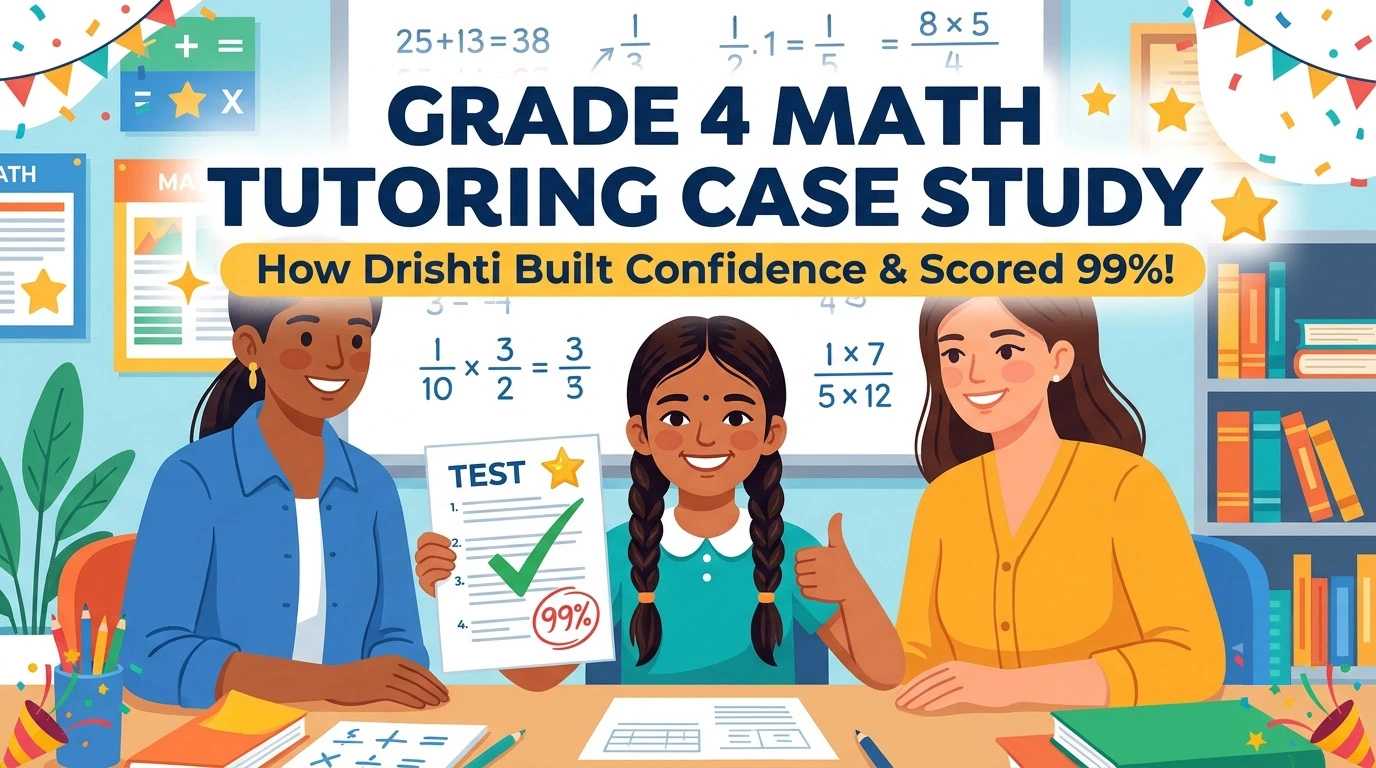
Drishti is a Grade 4 student in the United States who learns math with us at Guru At Home. She did not join us after a bad report card. She was not described as a student who had failed math. Instead, she needed help understanding concepts more clearly and learning to solve problems without waiting for someone to show her every step.
Since then, she has asked for extra classes, added Science alongside her Maths tutoring in the US, and finished her school year with 99%. This case study explains what her tutor, Miss Yashmita, actually did in those lessons, and what changed at each stage. Her mother, Sosalin, has written her own account publicly, and we have included it below.
Dristhi’s Progress At a Glance
| Student | Drishti |
| Grade | Grade 4 |
| Location | United States |
| Subjects | Started with Math, later added Science |
| Tutor | Miss Yashmita, Guru At Home |
| Lesson format | One-on-one, online |
| Where she started | Confused by some questions, low confidence in certain topics, a few gaps in understanding basics |
| Main goal | Understand concepts clearly and solve on her own |
| What changed | Improved confidence, independent problem solving, curiosity for new topics |
| School result | 99% – her family shared her report card with us |
| Parent review | 5 stars on Google from her mother, Sosalin Kundu |
Where the Student Started: Confusion Without a Lack of Ability
Nothing Was Broken. A Few Things Were Shaky.
Drishti could do math. That is important to say first, because parents often wait for a failing grade before asking for help, and by then the gap is wider.
What her tutor saw at the start was smaller and quieter:
- She sometimes got confused while solving problems.
- She lacked confidence in certain topics.
- A few basic concepts needed more practice and understanding.
These challenges can reinforce one another. When a student has an incomplete understanding of a concept, a question can feel harder than it needs to. Repeated confusion may then lead the student to wait for help instead of attempting the problem independently.
If several of these signs sound familiar, our guide to signs your child may need a tutor can help you recognize when additional academic support may be worth considering.
Why Grade 4 Math Can Become More Challenging
Grade 4 is where math stops being mostly counting and starts being mostly reasoning. Students work on multi-digit multiplication and division with remainders, equivalent fractions, adding and subtracting fractions with the same denominator, multiplying a fraction by a whole number, decimal notation for tenths and hundredths, and angles and shapes.
Fractions are the honest test. A student might memorize a procedure and use it successfully in a familiar exercise, yet struggle when the question changes or requires more than one step.
What Miss Yashmita Did Differently
The tutoring approach focused on four changes. Each addressed a specific learning need rather than treating confidence, understanding and practice as separate problems.
1. Explained Concepts in Simple Language
Miss Yashmita focused on making each concept easier to understand before expecting the student to apply a method. Instead of relying only on textbook wording or memorized steps, she explained the idea in language the student could follow. A Grade 4 student who hears “regroup the tens” before she has pictured what is happening will follow the steps and miss the point.
Once the idea was clear in plain words, the method was only the way to write it down. This is also how our Grade 4 math tutoring lessons are built: idea first, method second, speed last.
2. Build Confidence Through Practice
Confidence in math is not a pep talk. It is evidence. Miss Yashmita built it step by step, giving Drishti questions she could finish, then letting her see that she had finished them without help.
The aim was not simply to reassure her that she could do math. It was to help her experience the process of solving a question successfully. As the student became more comfortable with familiar concepts, she could approach the next challenge with greater confidence.
3. Encouraged Questions and Independent Thinking
The lessons encouraged the student to ask questions whenever something was unclear. She was also given opportunities to think through problems rather than simply watch the tutor demonstrate a solution.
This is the change most parents underrate. A child who says “I don’t get this part” has already done the hardest thing, which is noticing exactly where her understanding stopped. Over time, the goal is for students to attempt a maths question, explain their reasoning, and ask for help when they need it, rather than just saying it’s difficult or waiting for help.
4. Increased Difficulty at the Right Pace
As the student’s understanding improved, Miss Yashmita gradually introduced harder questions. The intention was to extend her learning without moving so quickly that she lost confidence. Push too early and the new confidence breaks. Wait too long and the student never learns that a difficult question is survivable.
Done at the right pace, hard questions stop being a threat and start being interesting. That is exactly what happened next.
What Changed During the Tutoring
The progress described in the original case notes involved more than completing individual questions correctly. It also included changes in how the student approached maths.
| Before | After |
|---|---|
| Got confused while solving problems | Solves problems confidently on her own |
| Waited to be shown the method | Thinks independently and asks questions when stuck |
| Low confidence in certain topics | Enjoys challenging questions |
| A few weak basic concepts | Strong enough base to take on new topics |
| Math only | Chose to join Science classes as well |
| Classes were something to attend | Always happy to attend extra classes when needed |
These observations describe the student’s reported experience. They should not be read as a controlled assessment or as a guarantee that every student will experience the same changes.
From Math to Science: When Curiosity Grows
Drishti started with Math and later chose to join Science classes too. That decision came from her, not from us, and it followed the same curiosity that made her comfortable with harder math questions. Math and Science require students to ask questions, understand concepts and apply what they learn to new situations. Although the subjects use different methods and content, both benefit from a willingness to investigate an idea.
Families who want both subjects with one platform can see how our online science tutors work alongside our online Indian math tutors.
The 99% School Result
Drishti finished her school year with an outstanding 99%. Her family shared her report card with us.
We would rather be accurate than impressive about this number, so two honest notes. First, a single school result is not a controlled measurement, and a different child doing the same work may see a different number. Second, and more useful for parents: the score came at the end, after the habits changed. The confidence, the questions and the independent solving arrived first. The result followed them.
In the Tutor’s Words
Over time, Drishti showed remarkable growth. She became a confident and capable learner who enjoys challenges and is always eager to learn more. Her hard work and dedication helped her achieve an outstanding result of 99% in school.
— Miss Yashmita, Drishti’s tutor
Two words in there matter more than the percentage: enjoy challenges. That is the opposite of where she started, and it is the part that travels with her into Grade 5 and everything after it.
What Her Mother Shared
Teaching notes show what happened inside the lesson. A parent sees the rest. Sosalin Kundu left a five-star Google review about her daughter’s math classes:
Yasmita is an exceptional math teacher who brings clarity, enthusiasm, and care to every lesson. Her teaching style makes even the most challenging topics easy to understand, combining clear explanations. My daughter consistently appreciate Yashmita’s patience and dedication. She is very punctual, knowledgeable and caring one.
— Sosalin Kundu, 5-star Google review
Read Sosalin’s original Google review
Two people describing the same lessons, writing separately, and agreeing. Sosalin’s review sits on our Google Business Profile, where families have rated us 4.8 out of 5 across more than 280 public reviews.
Why Personalized Math Tutoring Can Help
One Tutor, One Student, Every Week
None of what Miss Yashmita did is exotic. Explain simply, build confidence in order, make the student speak, raise the difficulty at the right moment. Any good teacher would agree with all four.
In a live, one-on-one online lesson, the tutor can focus on the student’s responses, ask follow-up questions, and adjust the explanation as needed. This creates an opportunity to address misunderstandings during the lesson rather than waiting until a test reveals them.
We see the same pattern with other students. Miss Yashmita also teaches two brothers in the United States, and our Grade 5 and Grade 8 math case study shows how the same teaching adjusts to two very different problems in the same family.
Is Your Child Experiencing Similar Math Challenges?
Six Signs Worth Watching in Grade 4
A child does not have to receive a low grade before needing help. It can be useful to pay attention to the way your child approaches questions and responds when something becomes difficult.
- She gets the right answer but cannot explain how she got it.
- Fractions are much harder for her than whole numbers.
- She goes quiet when she is stuck instead of asking.
- She waits for you to start the question with her.
- A topic she “knew” last month has disappeared this month.
- Her confidence drops before her grades do.
One of these on its own may mean nothing. Three or four together usually point the same way.
How Guru At Home Can Support Your Child
Every plan starts with the same question: is the real problem understanding, confidence, practice or focus? The fix is different for each one, and guessing wastes months. Book a free demo class with one of our tutors, and we will tell you honestly which of the four your child is dealing with before you commit to anything.
Frequently Asked Questions
1. What is Grade 4 math tutoring?
It is one-on-one teaching for students who are usually nine or ten years old. The work covers multi-digit multiplication and division, fractions, decimals, word problems and basic geometry, and it focuses on helping a child explain her thinking, not just produce an answer.
2. What did Drishti need help with at the start?
She sometimes got confused while solving problems, lacked confidence in certain topics, and needed to strengthen a few basic concepts.
3. Was she behind in math?
No, her tutor’s account does not describe her as failing or struggling. This was about understanding concepts more clearly and solving questions independently.
4. How did she reach 99%?
By changing how she worked, not by cramming. She learned each concept in plain language, built confidence on questions she could finish, started asking questions when unsure, and moved on to harder problems only when she was ready. The school result came at the end of that process.
5. Why do fractions cause so much trouble in Grade 4?
Because they are the first topic where copying a method stops working. A student has to understand what the fraction means before the rules for comparing or adding them make any sense.
6. My child never asks questions in class. Does that change?
It usually does in a one-on-one lesson, because there is no audience. Drishti was encouraged to ask whenever something was unclear, and asking became the habit that made everything else possible.
7. Can my child study two subjects with you?
Yes, Drishti started with Math and later added Science. Many families begin with one subject and add a second once the routine is settled.
8. How do online classes work for a child this age?
Lessons are live and one-on-one, so the tutor responds to how your child is thinking in the moment instead of marking her work afterwards. A free demo class lets you see the format before you decide.