
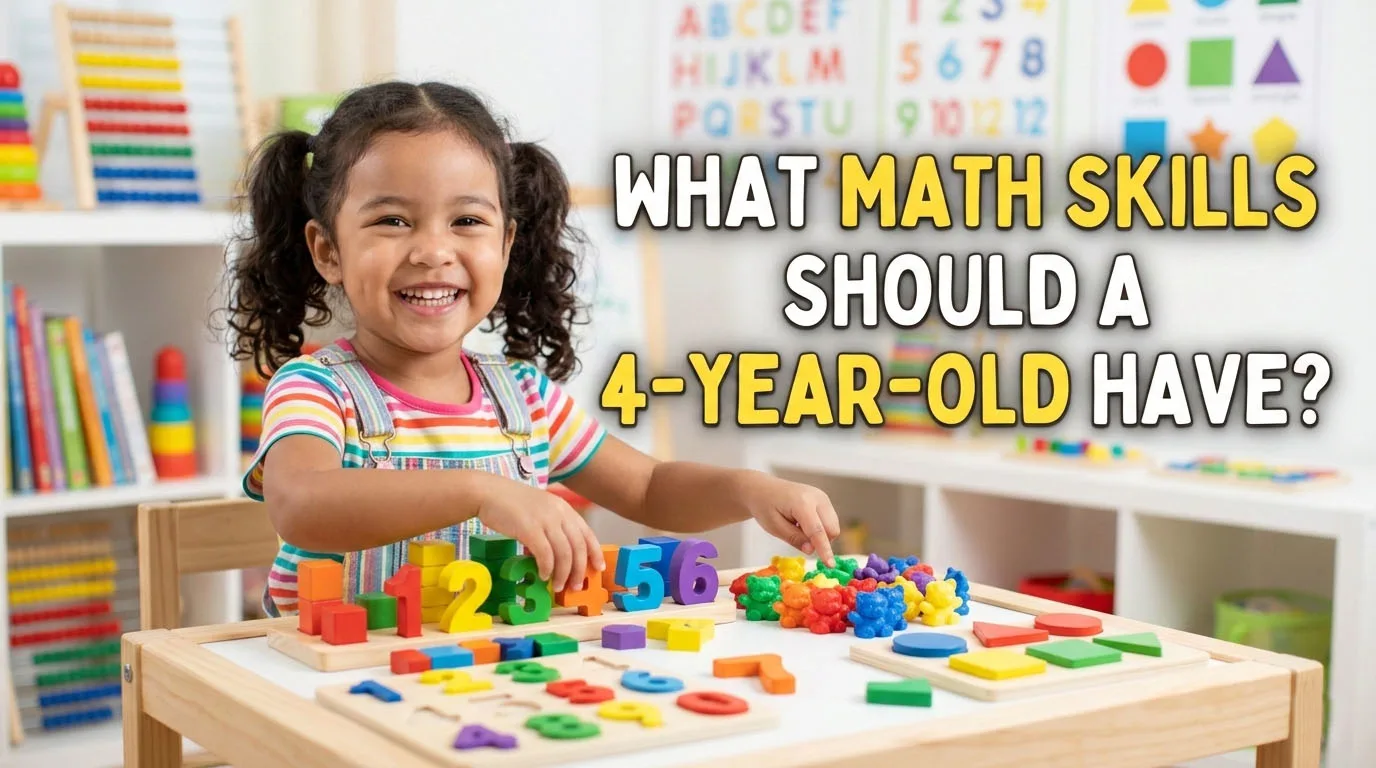
We often hear parents ask if their preschooler is “behind” in math.
It is a common worry.
You might hear another child counting to 100 in the park and wonder if you should be doing more flashcards.
The truth is, early math isn’t about how high a child can count. It is about how they think.
Research from early childhood educators shows that a 4-year-old’s brain is building the foundation for logic. This stage is critical. It predicts their future academic success even more than early reading skills do.
At Guru At Home, we design our online tutoring sessions to tap into this natural curiosity. We don’t just teach numbers; we teach children how to see math in the world around them.
Here are the 7 math skills your preschooler should be developing right now, and how you (and our online math tutors!) can help them master them.
- Recognizing and Counting Numbers Up to 20
There is a big difference between reciting numbers like a nursery rhyme and actually understanding them.
Many parents are thrilled when their 4-year-old can count to 50 or 100 verbally, but if you ask them to hand you “five spoons,” they might struggle.
This is because memorizing the order of words is a language skill, not a math skill.
At this age, the goal is one-to-one correspondence.
This means your child can point to one object and say “one,” point to the next and say “two,” without skipping items or counting the same one twice.
We also want them to start recognizing the visual symbols.
If they see the number 15 on a bus or a jersey, we want them to realize that those digits represent a number they know, even if they can’t write it perfectly themselves yet.
- Basic Addition and Subtraction Concepts for 4-Year-Olds
Please don’t worry about flashcards with plus and minus signs yet!
For a preschooler, addition and subtraction are about storytelling and changing quantities. It is about understanding that numbers aren’t static.
The best way to teach this is through “more” and “less.” If your child has two toy cars and you give them one more, ask, “Do you have more now or less?” If they eat three grapes from a bowl of ten, talk about how the number got smaller.
This helps them grasp the concept of the operation.
- Understanding Shapes and Spatial Concepts
Geometry isn’t just about drawing circles and squares; it is about how we navigate the physical world. While recognizing standard shapes is important, a 4-year-old’s brain is also working hard on spatial awareness.
This is the ability to understand where their body is in relation to other objects. This is where language becomes a powerful math tool.
Does your child understand positional words like under, over, between, and behind? If you say, “Put your shoes next to the door,” that is a geometry lesson.
We encourage parents to play games like “I Spy” that focus on these positions—for example, “I spy something square that is above the television.” It helps them map out their environment mentally.
- Logical Thinking and Problem-Solving in Math
We often think of math as just numbers, but at its core, math is logic. It is the ability to look at a problem and figure out a solution.
For a 4-year-old, this doesn’t mean solving a riddle; it means solving a practical life problem.
Try giving your child a “puzzle” during daily routines. For instance, “We have three friends coming over, but we only have two apples.
What should we do?” Watch how they think. Do they suggest cutting the apples? Do they go look for another one?
This process of identifying a shortage and brainstorming a solution is the foundation of critical thinking.
Our tutors love asking “Why?” questions to get kids to verbalize their logic, rather than just jumping to an answer.
- Sorting, Classifying Objects, and Pattern Recognition
Before a child can handle data or algebra, they need to learn how to organize chaos.
Sorting is one of the most natural math activities for preschoolers.
You can see this when they separate their LEGOs by color or put all their stuffed animals in one pile and hard toys in another. They are classifying based on an “attribute” (like texture, size, or color).
Once they can sort, they can start seeing patterns. Patterns are simply predictions—knowing what comes next.
A 4-year-old should be able to recognize and copy a simple “ABAB” pattern, like Red Block, Blue Block, Red Block, Blue Block.
Mastering this helps them understand that math creates order, a skill that eventually leads to understanding times tables and coding sequences.
- Introduction to Simple Estimation and Measurement Concepts
Your 4-year-old doesn’t need a ruler to learn measurement. In fact, using standard rulers can be confusing at this age. Instead, we focus on non-standard measurement.
This means measuring things using their own body or other objects. “How many steps does it take to get from the couch to the fridge?” or “How many blocks tall is the cat?”
This is also the perfect time to introduce estimation—the art of a “smart guess.” Ask them, “Do you think this jar holds more pennies or more tennis balls?” They are learning to compare volume and size. It teaches them to visualize space and quantity, which is much more valuable at this age than knowing exactly how many inches long a table is.
- Developing Math Vocabulary in Preschool Years
Language drives learning. If a child doesn’t have the words to describe what they see, it is harder for them to understand the concept.
A significant part of early math is simply building a robust comparative vocabulary.
We want 4-year-olds to move beyond just “big” and “small.”
We want them to use specific words like taller, shorter, heavier, lighter, wider, and narrower.
When you are at the grocery store, hold a watermelon and a lemon and ask, “Which one is heavier?”
When you are walking, ask, “Is that tree taller or shorter than our house?”
By using these words in casual conversation, you are giving them the tools to describe the mathematical world around them.
How to Support Your Child’s Math Journey
If your child isn’t mastering all these skills yet, don’t panic. Every child develops at their own pace. The goal is exposure, not perfection.
However, if you feel your child is avoiding numbers or struggling to grasp these concepts, a little extra support can make a world of difference. Math anxiety can start young, but so can math confidence.
At Guru At Home, we specialize in early childhood education that meets global standards. Our tutors are trained to make these abstract concepts feel like play. We work one-on-one with your child to build a foundation that will last a lifetime.
To discover how we make math fun, contact us today to schedule a complimentary trial session. Let’s get your little learner ready for the future.